
Why Are Global AI Stocks Falling in 2026? Nvidia, SoftBank and the AI Bubble Explained

Introduction: Why Is the Global AI Stock Market Falling?
The global artificial intelligence industry is facing a major financial test in November 2026. After years of excitement surrounding artificial intelligence, semiconductor technology and massive investments in AI infrastructure, investors are increasingly questioning whether the industry can generate enough profits to justify its enormous valuations.
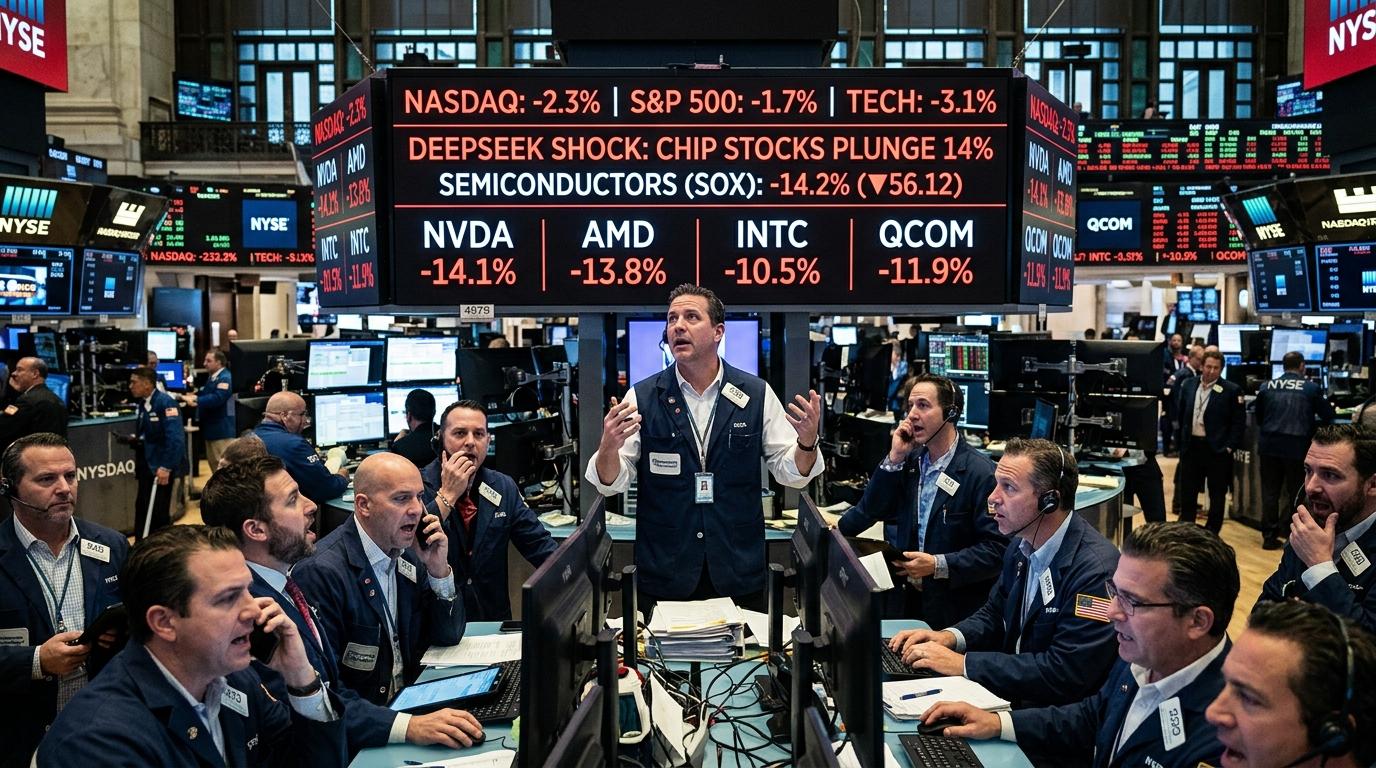
On November 20, global financial markets experienced another significant decline as technology and semiconductor stocks came under selling pressure. Japan's Nikkei 225 fell approximately 5.1%, South Korea's Kospi dropped 5.2%, and Taiwan's Taiex declined more than 6% during the latest reported trading session.
Major technology companies and AI-related businesses, including SoftBank, Samsung Electronics, SK Hynix and other semiconductor companies, were affected.
Interestingly, the market decline happened immediately after Anthropic made a strong stock market debut on Nasdaq. Instead of restoring confidence across the entire AI sector, the company's successful listing coincided with another wave of selling in established technology stocks.
This raises an important question: Is the artificial intelligence industry entering a financial bubble, or are investors simply adjusting their expectations?
In this report, we examine the reasons behind the global AI stock sell-off, the companies affected, the role of Nvidia and SoftBank, the risks surrounding AI infrastructure spending, and what the market could experience next.
1. What Happened to Global AI Stocks on November 20, 2026?
The latest decline affected several major financial markets, particularly in Asia.
According to Associated Press reporting, investors sold AI-related and semiconductor shares as concerns about the sustainability of the technology boom continued.
Major Stock Market Declines
The following figures represent reported market movements for November 20, 2026.
| Stock market | Reported decline |
|---|---|
| Japan's Nikkei 225 | 5.1% |
| South Korea's Kospi | 5.2% |
| Taiwan's Taiex | 6.23% |
| Australia's S&P/ASX 200 | 1.6% |
| Hong Kong's Hang Seng | Approximately 2% |
| Shanghai Composite | Approximately 1.2% |
These figures are reported closing or session figures, depending on the market and source.
The declines demonstrate that investor concerns are not limited to one company. Instead, selling pressure has spread across several countries and industries connected to artificial intelligence.
Why Are Asian Markets Particularly Vulnerable?
Asia plays an important role in the global AI supply chain.
South Korea produces advanced memory chips. Taiwan is a major semiconductor manufacturing hub. Japan supplies important semiconductor equipment and technology.
When investors become concerned about future AI spending, companies across this supply chain can face selling pressure.
Even businesses that are not directly developing AI models may experience stock declines because their future earnings depend partly on demand for AI infrastructure.
2. Why Are AI Stocks Falling? Five Major Reasons
There is no single explanation for the global sell-off. Several financial and economic concerns are influencing investor behaviour.
Reason 1: Fear of an AI Investment Bubble
One of the biggest concerns is whether artificial intelligence companies are becoming overvalued.
Technology businesses have attracted enormous investment because investors expect AI to transform healthcare, education, manufacturing, finance, software and other industries.
However, high expectations create financial risks.
Companies may spend billions developing AI models, purchasing chips and building data centres without generating enough revenue to justify their investment.
If investors begin to believe that future profits will be lower than expected, stock valuations can decline.
This is one reason the AI bubble debate has become increasingly important in 2026.
Reason 2: Massive AI Infrastructure Spending
Modern AI systems require enormous computing resources.
Technology companies are investing heavily in:
-
Advanced GPUs and AI processors
-
Large-scale data centres
-
High-speed networking equipment
-
Electricity and cooling infrastructure
-
Cloud computing capacity
-
Advanced semiconductor manufacturing
These investments are expensive.
The central financial question is whether future AI revenue will be sufficient to cover infrastructure costs and generate sustainable profits.
If AI companies continue increasing spending without achieving comparable revenue growth, investors may become less confident.
Reason 3: Concerns About Semiconductor Demand
Companies such as Nvidia, Samsung Electronics and SK Hynix are closely connected to the global semiconductor industry.
Their businesses benefit from demand for advanced computing technology, including products used in AI systems.
However, the market is beginning to examine whether current demand expectations are sustainable.
Investors are asking questions such as:
-
Will AI data centres continue expanding at the current pace?
-
Will technology companies reduce infrastructure budgets?
-
Could semiconductor supply eventually exceed demand?
-
Will cheaper AI technologies reduce demand for expensive computing hardware?
These questions can affect semiconductor valuations even when companies continue reporting strong business activity.
Reason 4: Higher Interest Rate Expectations
Interest rates are another important factor in technology stock valuations.
When investors expect borrowing costs to remain high or increase, companies may face more expensive financing.
This is particularly important for businesses investing heavily in infrastructure.
Higher interest rates can also make future profits less valuable when investors calculate company valuations.
Recent market reporting has highlighted interest-rate concerns alongside the decline in technology stocks and precious metals.
Reason 5: Investors Are Moving Money Between AI Companies
The Anthropic IPO introduced another important development.
Anthropic, the company behind the Claude AI assistant, made its Nasdaq debut on November 19, 2026.
Its shares gained approximately 17% on their first trading day, despite opening substantially above the IPO price.
However, the successful debut did not prevent established AI and semiconductor stocks from falling.
Some analysts have suggested that investors may be reallocating money between AI investments rather than abandoning the entire industry.
This distinction matters because a stock market correction does not automatically mean that artificial intelligence technology is failing.
3. Nvidia: Why the AI Chip Giant Is Facing Investor Pressure
Nvidia is one of the most important companies in the global artificial intelligence ecosystem.
Its graphics processing units (GPUs) are widely used to train and operate advanced AI systems.
Major technology companies depend on powerful computing hardware to develop AI models, operate data centres and provide cloud services.
However, Nvidia's market performance is also closely connected to investor expectations.
Why Are Investors Watching Nvidia?
Investors are particularly interested in three areas:
AI Hardware Demand: Will companies continue purchasing advanced GPUs at the current rate?
Data Centre Investment: Will major technology companies maintain their spending plans?
Future Profitability: Can Nvidia maintain strong earnings growth as competition increases?
Even when a company has strong financial results, its stock price can decline if investors believe future growth expectations are too optimistic.
Recent reporting indicated that Nvidia shares fell approximately 2.9% during the preceding Wall Street session.
This decline occurred during a broader technology sell-off.
Is Nvidia's AI Business in Trouble?
A falling stock price does not necessarily mean that Nvidia's underlying business is failing.
The important distinction is between company performance and stock market valuation.
A business can continue generating substantial revenue while its shares decline because investors are reassessing how much they are willing to pay for future earnings.
Nvidia's long-term outlook will depend on AI infrastructure demand, competition, innovation and customer spending.
4. SoftBank Stock Falls: Why Its OpenAI Investment Matters
SoftBank Group became another major focus during the November 20 market decline.
The Japanese investment company has significant exposure to artificial intelligence through its investment portfolio.
One of its most important AI-related commitments involves OpenAI.
According to CNBC reporting cited by financial news coverage, SoftBank had invested approximately $64.6 billion in OpenAI.
Why Did SoftBank Shares Fall?
SoftBank shares declined sharply during Friday's Asian trading session.
One report recorded a 16.16% fall during early trading, while other reports recorded different intraday or session figures.
The decline reflected investor concerns about the company's exposure to AI investments and the broader technology market.
Investors are examining whether enormous investments in AI businesses will generate sufficient future returns.
What Does This Mean for OpenAI?
SoftBank's share-price decline does not mean OpenAI has failed or that its technology is losing popularity.
It highlights a different financial issue: companies investing heavily in AI may face greater market pressure when investors become uncertain about future returns.
The success of AI investments will ultimately depend on commercial demand, operating costs, competition and sustainable profitability.
5. Samsung and SK Hynix: Why Semiconductor Companies Are Affected
Samsung Electronics and SK Hynix are important companies in the global memory semiconductor industry.
Their products play an important role in modern computing systems, including AI servers and data centres.
Samsung Electronics
Samsung manufactures memory chips and other electronic components used across the technology industry.
AI data centres require significant memory capacity, making advanced memory products an important part of the AI infrastructure market.
However, when investors become concerned about future semiconductor demand, Samsung shares can also experience pressure.
SK Hynix
SK Hynix is another major memory semiconductor manufacturer.
Its high-bandwidth memory products are particularly relevant to advanced AI computing systems.
Demand for these products has benefited from the growth of AI infrastructure.
However, market expectations can change quickly.
Investors are now considering whether the current pace of AI-related investment can continue.
Why Does This Matter?
The AI industry depends on a connected ecosystem.
AI model developers need computing hardware. Data centres need processors and memory. Semiconductor companies depend on orders from technology businesses.
A slowdown in one part of this ecosystem can affect companies throughout the supply chain.
6. Is the AI Bubble Similar to the Dot-Com Crash of 2000?
The comparison between today's AI market and the dot-com bubble is becoming increasingly common.
During the late 1990s, investors poured money into internet-related companies because they expected the internet to transform the global economy.
Many businesses achieved enormous valuations despite having weak financial foundations.
When investor confidence collapsed, numerous technology stocks lost substantial value.
Similarities Between the AI Boom and Dot-Com Era
There are several similarities:
-
Extremely high expectations for new technology.
-
Significant investor interest in technology companies.
-
Large investments based on future growth.
-
Concerns about valuations and profitability.
-
The possibility that some businesses may fail to meet expectations.
Important Differences
However, there are also important differences.
Today's leading AI companies include established businesses with substantial existing revenue, customers, infrastructure and commercial operations.
Artificial intelligence is already being used in software development, business automation, cloud computing and enterprise services.
Therefore, the current AI market should not automatically be treated as identical to the dot-com crash.
The more useful question is whether individual company valuations accurately reflect their future earning potential.
7. Will AI Investment Continue Growing in 2027?
Despite the recent market decline, artificial intelligence remains an important technology investment area.
Companies across different industries are continuing to explore AI applications.
Some major investment areas include:
AI Data Centres: Facilities designed to provide the computing power needed for advanced AI models.
Enterprise AI: Business software that automates tasks and improves productivity.
AI Chips: Processors designed for machine learning and advanced computing.
Cloud Computing: Online infrastructure that allows businesses to access AI services.
Robotics: Intelligent machines designed to perform physical tasks.
Gartner projections cited in recent market reporting estimated global AI-related investment at $2.7 trillion in 2026 and $3.6 trillion in 2027.
These are industry investment projections, not guaranteed spending or confirmed future revenue.
The actual investment outlook will depend on economic conditions, business demand, financing costs and the financial returns achieved by AI companies.
8. What Should Investors Watch Next?
Investors following the AI market should pay attention to several important indicators.
1. Nvidia's Financial Results
Revenue growth, data centre sales and management guidance can provide information about demand for AI computing hardware.
2. Big Technology Companies' Capital Expenditure
Capital expenditure, commonly called CapEx, measures how much companies spend on long-term assets such as data centres and computing infrastructure.
Changes in planned spending can influence semiconductor companies.
3. AI Company Profitability
Investors need to understand whether AI businesses can generate sufficient revenue to cover development and operating costs.
4. Central Bank Interest Rate Decisions
Interest rate expectations influence borrowing costs and financial market valuations.
5. Semiconductor Demand
Orders for memory chips, GPUs and advanced manufacturing equipment can provide clues about the direction of the AI industry.
9. Could Global AI Stocks Recover?
A recovery is possible, but it is not guaranteed.
The market could improve if companies demonstrate strong AI revenue growth, infrastructure investments generate attractive returns and economic conditions become more favourable.
On the other hand, stocks could face further pressure if investors conclude that AI valuations remain too high or infrastructure spending is growing faster than commercial demand.
It is also possible for some AI companies to perform strongly while other businesses struggle.
This is why investors should avoid treating the entire artificial intelligence industry as one investment.
10. Final Verdict: Is the AI Industry in Danger?
The November 2026 global AI stock sell-off highlights an important change in investor sentiment.
For several years, markets focused heavily on the potential of artificial intelligence.
Now investors are paying closer attention to costs, valuations, infrastructure spending and the ability of companies to generate sustainable profits.
Nvidia, SoftBank, Samsung and SK Hynix are important examples of businesses affected by changing expectations across the technology sector.
However, falling stock prices do not prove that AI technology is failing.
The industry continues to have significant commercial applications, but future success will depend on whether investment translates into real economic value.
The biggest question for 2027 is no longer simply how powerful AI can become. It is how much money businesses can actually make from it.
BBS Alerts News 24 will continue monitoring global AI investment, semiconductor markets and technology developments.
Frequently Asked Questions
Why are global AI stocks falling in November 2026?
Global AI stocks are falling because investors are concerned about high valuations, expensive AI infrastructure, future profitability, semiconductor demand and interest-rate expectations.
Is there an AI stock market bubble in 2026?
There are growing concerns about an AI investment bubble, but a market correction alone does not prove that a bubble has burst. Company valuations and future earnings need to be examined individually.
Why is Nvidia stock falling?
Nvidia shares have faced pressure during the broader technology sell-off as investors reassess AI hardware demand, data centre spending and future growth expectations.
Why did SoftBank stock fall?
SoftBank experienced a sharp decline amid concerns about its significant AI investments, including its reported $64.6 billion investment in OpenAI, and broader weakness in technology stocks.
Why are Samsung and SK Hynix affected by AI stock declines?
Both companies are major semiconductor businesses supplying products used in advanced computing and AI infrastructure. Concerns about future chip demand can affect their stock prices.
Did Anthropic's IPO cause the global AI stock crash?
There is no established evidence that Anthropic's IPO alone caused the sell-off. The decline reflected wider investor concerns about AI valuations, spending and technology-sector expectations.
Will AI stocks recover in 2027?
A recovery is possible if AI companies deliver sustainable revenue growth and investors regain confidence. However, stock market performance remains uncertain.
Is Nvidia still important for artificial intelligence?
Yes. Nvidia remains a major supplier of GPUs and computing technology used in AI training, inference and data centre infrastructure.
What is the difference between an AI bubble and an AI market correction?
An AI market correction is a decline in stock prices. An AI bubble describes a situation in which asset prices become excessively inflated relative to their underlying financial value.
Is investing in AI stocks risky?
AI stocks can carry risks related to high valuations, competition, technology changes, infrastructure costs, regulation and economic conditions. Investors should research individual businesses and consider their financial circumstances before making investment decisions.
Editorial Note
This article is an independent news analysis based on reported market data and published financial reporting available on November 20, 2026. Market figures can change, and this article does not constitute investment advice.


Comments (0)