
China Economy 2026: Beijing Steps Up Support as Domestic Demand Weakens
The China economy in 2026 is entering a more challenging phase as weaker domestic demand, slowing consumer spending, declining investment and continued pressure in the property sector weigh on economic momentum.
Chinese authorities are now preparing additional fiscal and financial measures to strengthen domestic demand and support economic activity during the second half of the year.
The latest policy direction was highlighted by Chinese officials on August 21 and 22, with Beijing emphasizing faster fiscal spending, stronger coordination between fiscal and financial policies, and additional support for households and businesses
China Economy 2026: Latest Economic Situation
China remains one of the world's largest economies, but its recovery has become increasingly uneven.
Official economic data showed that China's GDP growth slowed to 4.3% year-on-year in the second quarter of 2026, compared with 5% in the first quarter.
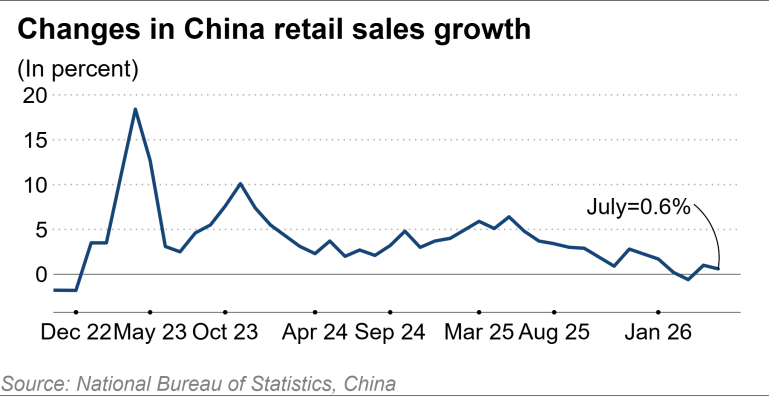
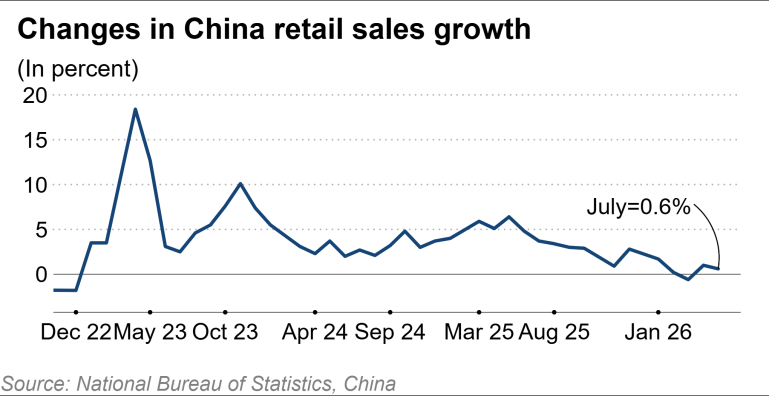
July data also showed weaker momentum. Industrial production increased by 4.5% year-on-year, while retail sales rose only 0.6%. Fixed-asset investment declined 6.7% during the first seven months of the year.
These figures have increased pressure on Beijing to strengthen economic support.
Why Is China's Economy Slowing?
One of the biggest challenges facing China is weak domestic demand.
Chinese households have remained cautious about spending, while private investment has also weakened.
The country's property market remains another major source of economic pressure. A prolonged downturn in real estate has affected construction, investment, household confidence and related industries.
At the same time, external risks, global trade tensions and geopolitical uncertainty are creating additional challenges for the world's second-largest economy.
China Retail Sales Show Weak Consumer Demand
Consumer spending is an important indicator of China's economic health.
In July 2026, retail sales increased only 0.6% year-on-year, slowing from 1% growth in June.
The figure was also weaker than economists had expected.
The slowdown suggests that Chinese consumers remain cautious despite government efforts to encourage spending.
Strengthening household consumption has therefore become one of Beijing's major economic priorities.
China Announces New Fiscal Support
Chinese authorities have announced plans to accelerate fiscal spending during the second half of 2026.
The government is also working on stronger coordination between fiscal, monetary and industrial policies.
The objective is to support domestic demand, stabilize investment and put the economy on a stronger footing.
Officials have indicated that already-funded infrastructure projects will receive faster spending rather than relying entirely on a completely new large-scale stimulus package.
Interest Subsidies for Businesses and Consumers
One of the measures announced by Chinese authorities involves expanded loan interest subsidies.
Eligible small businesses and consumers can receive support equivalent to a 1% interest subsidy on certain loans and credit-card installment products, with higher support limits under the updated arrangements.
The goal is to make borrowing cheaper and encourage businesses and consumers to spend and invest.
This approach could provide targeted support without requiring Beijing to launch an extremely large economy-wide stimulus programme.
China Wants to Boost Domestic Consumption
Domestic consumption is becoming increasingly important for China's economic strategy.
For years, China's growth model benefited heavily from investment, manufacturing and exports.
However, policymakers increasingly want household consumption to play a larger role in sustaining economic growth.
The latest measures therefore focus on supporting households, encouraging spending and improving consumer confidence.
China's Property Market Remains a Major Challenge
The property sector continues to be one of the most important weaknesses in China's economy.
Falling property investment and weaker housing-market confidence have affected businesses and households.
The real estate downturn also creates pressure on local governments because property-related activity has historically generated significant revenue and economic activity.
A stable property market could therefore be important for China's broader economic recovery.
China Investment Faces Pressure
Investment has also weakened significantly.
Fixed-asset investment declined during the first seven months of 2026, reflecting weakness in several areas of the economy.
The decline in private-sector investment is particularly important because businesses are more likely to expand when they have confidence in future demand.
Beijing is therefore trying to use fiscal policy and infrastructure spending to stabilize investment and maintain economic activity.
China's Manufacturing Sector Remains Strong in Some Areas
Despite the broader slowdown, not every part of China's economy is weak.
High-tech manufacturing, artificial intelligence-related industries and technology exports have remained relatively strong.
China's exports have provided an important source of economic support, creating a significant contrast between strong external demand and weaker domestic consumption.
This imbalance is becoming one of the major economic issues facing Beijing.
China Exports Continue to Support Growth
China's export sector has remained resilient despite weaker domestic demand.
Strong exports, particularly in technology and manufacturing, have helped offset some of the weakness inside the Chinese economy.
However, greater dependence on exports can create new challenges if international demand weakens or trade tensions increase.
China therefore wants to strengthen domestic consumption while continuing to maintain its global manufacturing and export competitiveness.
China's AI Industry and Economic Growth
Artificial intelligence is becoming an increasingly important part of China's economic strategy.
Investment in AI-related manufacturing, electronics and advanced technology has helped support industrial activity.
The country's technology sector has also contributed to strong export performance.
However, technology-led production alone may not solve China's domestic-demand problem if households remain reluctant to spend.
China's 2026 GDP Growth Target
China's official 2026 economic growth target is around 4.5% to 5%.
The 4.3% year-on-year GDP growth recorded in the second quarter was below the lower end of that target.
This has increased expectations that policymakers will continue adjusting economic policies during the second half of the year.
The International Monetary Fund's current country information projects China's 2026 real GDP growth at 4.6%, although forecasts can change as economic conditions develop.
Will China Introduce a Major Stimulus Package?
At present, Beijing's approach appears focused more on targeted fiscal and financial support than on announcing one massive new stimulus programme.
Authorities are emphasizing faster implementation of existing fiscal plans, additional support for households and businesses, infrastructure spending and improved policy coordination.
The approach suggests that policymakers want to stabilize growth while also controlling financial and fiscal risks.
What Does China's Economic Slowdown Mean for the World?
China is deeply integrated into global trade.
A significant slowdown could affect commodity demand, manufacturing supply chains, international trade and businesses that depend on Chinese consumers.
On the other hand, continued strength in Chinese exports and manufacturing could increase competition for producers in other countries.
The direction of China's economy therefore matters not only for Asia but for the global economy.
Impact on Pakistan
China is particularly important for Pakistan because the two countries have extensive economic, trade and infrastructure ties.
Changes in China's economic growth can influence Pakistani imports, machinery supplies, commodity demand, investment and major infrastructure projects.
If China's economy accelerates, demand for imports and investment could strengthen.
If growth slows significantly, Pakistani businesses connected to Chinese trade could face weaker demand or changes in investment patterns.
China Economy and Global Oil Demand
China is also one of the world's largest energy consumers.
Changes in industrial production, transportation and consumer activity can influence global demand for oil and other commodities.
A weaker Chinese economy could reduce some commodity-demand pressures, while stronger government stimulus could support industrial activity and energy consumption.
This makes China's economic policies important for global commodity markets as well.
What Happens Next for China's Economy?
The next several months will be important for determining whether Beijing's latest policies can successfully strengthen domestic demand.
Key indicators to watch include:
- Retail sales
- Industrial production
- Fixed-asset investment
- Property investment
- Consumer confidence
- Manufacturing activity
- Export growth
- Inflation
- Government fiscal spending
- AI and high-tech investment
If domestic consumption improves, China's economic growth could stabilize.
If consumer demand and private investment remain weak, authorities may face pressure to introduce additional measures.
China Economy 2026: Key Points
- China's GDP growth slowed to 4.3% year-on-year in Q2 2026.
- China's economic momentum weakened further in July.
- Retail sales increased only 0.6% year-on-year in July.
- Industrial production grew 4.5% year-on-year in July.
- Fixed-asset investment declined 6.7% during the first seven months.
- Domestic demand remains one of China's biggest economic challenges.
- Beijing plans additional fiscal and financial support.
- Authorities are accelerating fiscal spending.
- Interest subsidies are being expanded for eligible businesses and consumers.
- China's technology and export sectors remain relatively strong.
- The property market continues to weigh on economic activity.
- China's 2026 GDP growth target is around 4.5%–5%.
Conclusion
The China economy in 2026 is facing a critical period.
While China's technology industries, manufacturing capabilities and exports continue to provide important support, weaker consumer spending, declining investment and the prolonged property downturn are creating significant pressure.
Beijing is responding by accelerating fiscal spending and introducing targeted financial measures designed to encourage consumption, support businesses and stabilize investment.
The success of these measures will depend largely on whether they can restore consumer confidence and encourage private investment.
For the global economy, China's performance will remain highly important. A stronger Chinese recovery could support global trade and commodity demand, while a prolonged slowdown could create new challenges for manufacturers, exporters and economies closely connected to China.
The second half of 2026 will therefore be closely watched by investors, businesses and policymakers around the world.
Disclaimer: This article is based on publicly reported economic information available as of August 22, 2026. Economic data, government policies and forecasts can change as new information becomes available.

Comments (0)